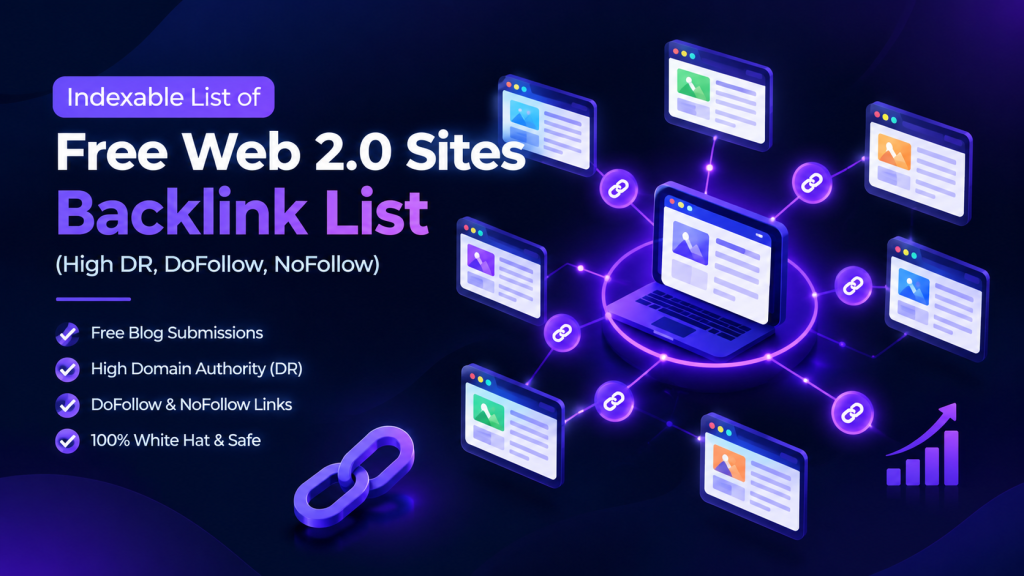
A working list of Web 2.0 platforms that still get indexed, still pass link equity, and still help you build a natural-looking link profile — without spending a single rupee.
Web 2.0 backlinks get written off a lot faster than they deserve. Yes, most SEOs use them badly — one throwaway post, an exact-match anchor, and zero interlinking. But used properly, these platforms still do real work: fast indexing, aged domain trust, and a link profile that looks like it grew naturally instead of being bought in bulk.
Below is the list our team actually uses on client campaigns, split by how we deploy them — direct foundational links, and tier-2 support links for indexing and diversity. We've also expanded this edition with a benefits breakdown, platform-by-platform notes, and an FAQ section so you have everything in one place.
What Are Web 2.0 Backlinks?
A Web 2.0 backlink comes from a free publishing platform — think Medium, Tumblr, or Blogger — where anyone can create a profile or mini-site and publish content with an outbound link back to a target page. Because these platforms are decades-old in many cases, Google already trusts the root domain. Your content simply borrows that trust.
Used as a one-off, a single Web 2.0 post does very little. Used as a small network of interlinked profiles pointing into your main site or a tier-1 asset, they become a legitimate foundational layer under any link building campaign.
The reason they've survived multiple algorithm updates comes down to three things: the domains themselves are old and trusted, the content on them is genuinely user-generated (which Google has leaned into more since 2024), and they cost nothing to build at scale — which means a small agency or an in-house team can run the same foundational layer a larger competitor pays thousands for.
Why Web 2.0s Still Belong in Your Link Profile
Aged Domain Trust
You're publishing on domains with years or decades of history — trust your content alone could never earn overnight.
Fast Indexing
Top platforms like Medium and LinkedIn Pulse get crawled in hours, which helps pull newer or weaker pages into the index faster too.
Zero Cost, High Scale
No per-link fee. With the right process, a team can build dozens of properly structured profiles in a week.
Natural Link Diversity
A profile made entirely of guest posts and niche edits looks engineered. Web 2.0s add the variety a real link profile has.
The 6 Platforms We Lean On Most
Out of all 30, these are the ones that carry the most weight in an actual campaign — highest trust, fastest indexing, or the most flexible content structure.
The 2026 Web 2.0 Sites List
Here is the full list with Domain Authority, link type, and how fast each one tends to get indexed based on current testing.
| # | Site | DA | Link Type | Indexing Speed |
|---|---|---|---|---|
| 1 | Medium.com | 95 | Follow | Fast |
| 2 | Substack.com | 86 | Follow | Moderate |
| 3 | Vocal.Media | 76 | NoFollow | Fast |
| 4 | Tealfeed.com | 59 | Follow | Slow |
| 5 | LinkedIn Pulse | 97 | NoFollow | Near-instant |
| 6 | About.me | 92 | Follow | Fast |
| 7 | Strikingly.com | 72 | Follow | Medium |
| 8 | Weebly.com | 93 | Follow | Fast |
| 9 | Jimdo.com | 89 | NoFollow | Moderate |
| 10 | Write.as | 75 | Follow | Fast |
| 11 | Tumblr.com | 94 | Follow | Moderate |
| 12 | Blogger.com | 92 | Follow | Fast |
| 13 | Site123.com | 82 | Follow | Slow |
| 14 | Webs.com | 82 | Follow | Moderate |
| 15 | Webnode.com | 81 | Follow | Slow |
| 16 | Tripod.lycos.com | 91 | Follow | Slow |
| 17 | Zoho Sites | 86 | Follow | Medium |
| 18 | Yola.com | 87 | Follow | Slow |
| 19 | Bravenet.com | 78 | Follow | Very Slow |
| 20 | Pen.io | 76 | Follow | Fast |
| 21 | Muckrack.com | 92 | Follow | Fast |
| 22 | Wattpad.com | 91 | NoFollow | Medium |
| 23 | Steemit.com | 88 | Follow | Fast |
| 24 | Issuu.com | 94 | Follow | Fast |
| 25 | Hackernoon.com | 91 | Follow | Moderate |
| 26 | WordPress.com | 94 | Follow | Fast |
| 27 | Wix.com (site) | 88 | Follow | Fast |
| 28 | Hashnode.com | 82 | Follow | Fast |
| 29 | LiveJournal.com | 89 | Follow | Slow |
| 30 | Edublogs.org | 80 | Follow | Moderate |
How to Actually Use These Without Wasting Them
1. Don't post once and disappear
A single 300-word post with one exact-match anchor is exactly the pattern Google's spam systems are tuned to catch. Treat each top-tier platform (Medium, Substack, Blogger, About.me) like a small property: 2–3 posts minimum, spaced out, interlinked.
2. Keep the anchor mix natural
Roughly 70–80% brand, naked URL, or generic anchors ("this guide", "read more"). Keep exact-match anchors to around 10% of the total, and never repeat the same exact-match phrase across multiple properties.
3. Interlink the network
Isolated profiles that never reference each other don't resemble a real content ecosystem — they look exactly like what they are. Link your Substack post to your Medium post, your Medium post to your About.me, and let a couple of them point into your main site or a tier-1 asset.
4. Don't skip indexing
A link that never gets crawled passes nothing. Submit URLs through Google Search Console where the platform allows a custom domain, and support slower-indexing properties (Bravenet, Webnode, Tripod) with a link from something that indexes fast, like Blogger or LinkedIn Pulse.
Common Mistakes to Avoid
- Zero interlinking — isolated Web 2.0 profiles carry far less weight than a small interlinked cluster.
- Exact-match overload — the fastest way to trip a spam filter and burn the whole batch.
- Unformatted AI content — a wall of generic text with no headers, structure, or intent match rarely ranks or holds its place in the index.
- No CTA or purpose — every post should link somewhere with intent, not just exist to hold a backlink.
Frequently Asked Questions
Are Web 2.0 backlinks still safe to build in 2026?
Yes, as long as they're built with a natural anchor mix, spaced-out publishing, and real content. Mass-produced spun content on 50 profiles in a day is what triggers penalties — not the platforms themselves.
How many Web 2.0 links does a site need?
There's no fixed number. Most campaigns use a small foundational layer (5–15 well-built properties) rather than dozens of thin ones — quality and structure matter more than volume.
Do Web 2.0 links replace guest posts and niche edits?
No — they support them. Web 2.0s form the foundational layer of a link profile; guest posts and niche edits are the authority layer on top.
Which platform should I start with?
Medium and About.me are the easiest starting points — high trust, fast indexing, and flexible enough to build a proper mini-profile on day one.
Want this built for you instead of DIY?
Our team runs this exact Web 2.0 + tiered link building process for clients as part of a structured, white-hat campaign — fully managed, with a complete report at the end.
See Link Building Packages Talk to Our Team